

On Outsourcing Your Worth
The absurdity of performance culture in tech

There is a specific kind of madness that happens when you spend years letting a company tell you whether you are good enough.
Not whether your work was useful, or whether the project landed, or whether a goal was met.
Whether you are good enough.
This is what performance culture does, especially in tech and high-pressure environments. It is not just that the expectations are high, It’s that, slowly, you start outsourcing your worth.
At some point you really have to ask whether these corporate systems are actually measuring performance, or whether they are deliberately nurturing insecurity in their employees for their own benefit and calling it performance management.

It’s not you, it’s the system
Let me tell you about the time I got a great performance review but had to ask my manager to please tell me what I did so I could do it again, because I was confused.
When I say this company takes the cake, I mean it takes the cake so much that I almost don’t remember what performance culture looked like at the other places. I just know they were not this bad.
The whole year had been a total shit show. I didn’t know what the definition of success was, and even my manager couldn’t tell me, because she didn’t know either, and I don’t blame her, as the ball was constantly moving on her level, too.
I describe it to people like this: imagine starting a race and being told there’s no finish line. You just keep running, and when the whistle blows, you stop, and whoever has run the farthest wins.
My solution to this, as a person who takes her work very seriously, was to run fast and hard. Do everything as excellently as I possibly could and hope for the best.
I went into the performance meeting expecting to be decimated, but my rating was actually really good! I was so shocked!
So I asked my manager, “Please tell me what I did so I can do it again next year.”
Isn’t that crazy? How can I be performing well and still not know what performance means? How can a system reward you and leave you with no real understanding of what success is?
In hindsight, I see it for what it was. I see that the system was not clear… It was just confident. And because the system sounds confident, you start assuming you must be the confused one, and there must be something wrong with you.
But no. Sometimes the system is confused too; it has just learned how to make that confusion your problem.
Sinem had a similar experience.
“Your goals are just the beginning”
This one is personal. It’s the kind of story I’ve heard from too many women in corporate. A woman is pregnant and having a really difficult time. She has conversations with the person she’s reporting to about what she needs to be able to keep delivering to be ok, and she does all those things. But when performance evaluation comes, the verdict is that she isn’t quite meeting expectations.
Somehow, the goalpost has changed.
A common language I’ve heard used in these moments is, “Your goals are just the beginning.”
Your goals are just the beginning? So you can hit your goals, and you’re still not performing? Then what are the goals for?
This is how these systems make you feel like you are losing your mind. The target moves, the language changes, and the expectations become vibes. You think you agreed to one thing, and then the evaluation comes, and suddenly there is another thing, another dimension, another yes, but you didn’t see it coming.
Yes, you hit your goals, but your goals were just the beginning.
Yes, you did the work, but was your impact visible enough?
Yes, your manager thinks you’re doing well, but what do other managers in the room think?
Yes, you delivered, but did you deliver in the right way, to the right people, at the right level of perceived strategic importance?
It is all so ridiculous, people.
Because here’s the thing: in these systems, everything matters. Hit the goals. Be visible. Build the narrative. Manage up. Manage sideways. Have impact. Have presence. Be strategic. And then in the room, someone gets to pick which one of those mattered most this cycle. Whichever one you missed, that’s the one they’ll point to.
That is not performance management. That is moving the goalpost and calling it excellence.
The room you are not in
And then there is the part most people don’t see clearly: the calibration room. The room where your work is discussed without you, where you can’t defend yourself.
Your performance review is not always just between you and your manager. Your manager can think you are great, put you up for promotion, and write a positive review. And then it goes into a room. And in that room, if one other manager has any doubt about you — one — it can affect the outcome. The doubt does not have to be deep or evidence-based. It could be, oh, she didn’t respond to my email. It could even be someone who just wants to promote someone on their own team and beats you down to make room.
(I just had to drop a comment on this post I saw on LinkedIn:)
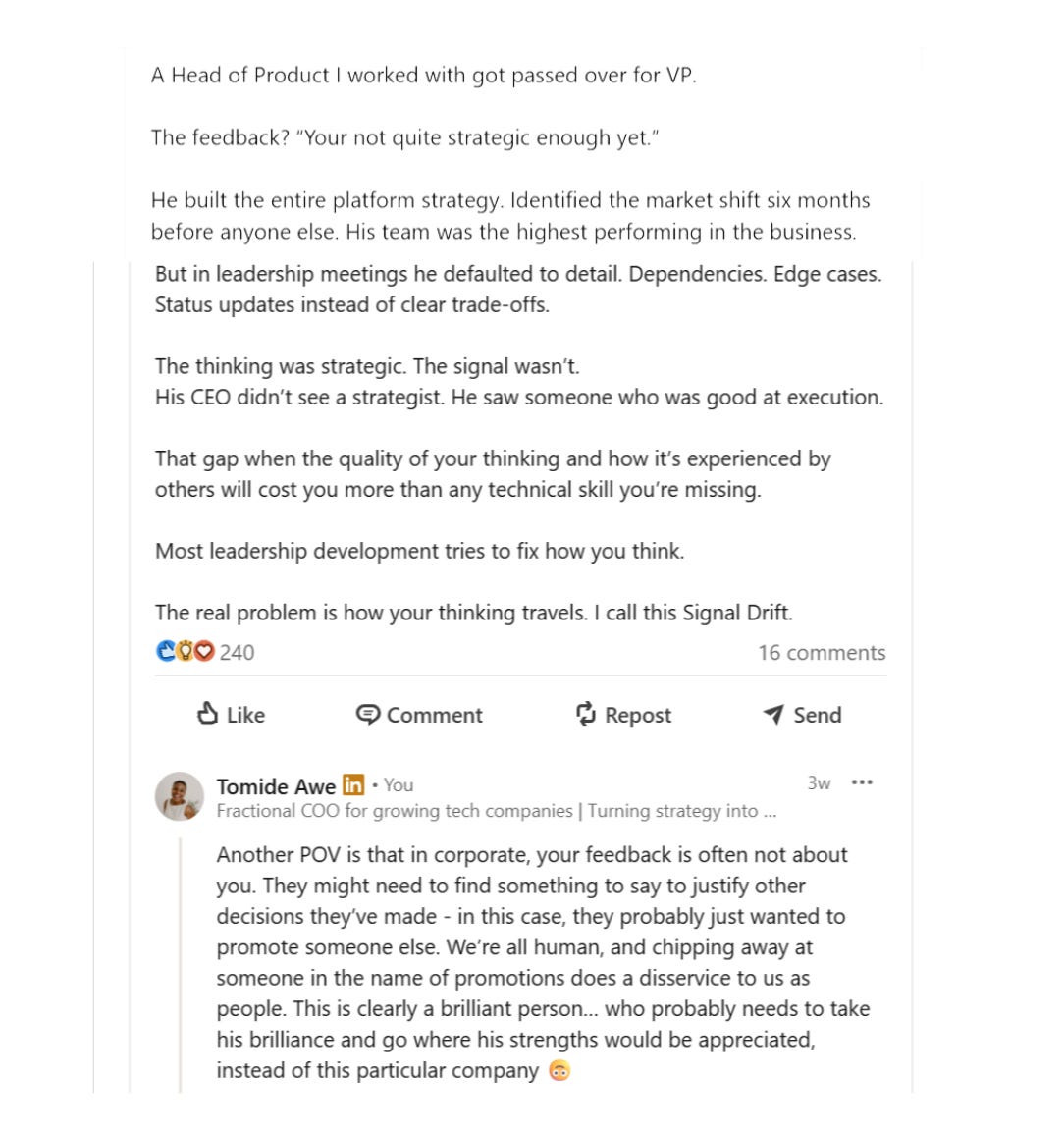
Suddenly, your performance is not being evaluated; it’s being negotiated.
Your work becomes a debate, your rating becomes a discussion, and your future depends on how well someone else can defend you in a room you are not in.
And then the person on the receiving end is expected to absorb the outcome as truth.
Performance culture is the real Hunger Games.
I’m sorry, am I a chair?
And then there is stack ranking… like, I’m sorry, am I a chair?
Why are you stack-ranking me against other individuals? Human beings with different roles, different managers, different projects, different levels of support, different visibility, different life circumstances, different political capital. But somehow everybody gets lined up and compared.
Or is it the forced bell curve, which is its own special kind of madness? Even if a team is full of strong performers (these companies boast about hiring the best of the best for a reason), the system needs the shape of the curve. Someone has to be at the top, someone has to be in the middle, and someone has to be below. Not because they are bad, but because the curve demands it.
So again, are we measuring performance, or are we manufacturing insecurity? A system that requires someone to be below so the model can look balanced is not just measuring performance; it’s creating scarcity and anxiety, and telling people that even if everyone is strong, someone still has to lose.
This is the game, and in my opinion, the game is madness.
Here’s the scam and how to un-scam yourself
I don’t have an issue with feedback, excellence, ambition, or accountability. I believe in all of those things.
The problem is when performance culture becomes a confusing mix of unclear goals, moving targets, subjective rooms, forced comparison, and corporate language that makes everything sound more reasonable than it actually is. People are told to be authentic but rewarded for being strategic. Told to collaborate but ranked against each other. Told to own their growth but not given clarity. Told the system is fair, even when everyone knows your manager’s ability to advocate for you can change the outcome. And then companies benefit from all that extra effort while still reserving the right to say, hmm, not quite.
That is the scam. And yes, I said scam.
If people leave these environments with their nervous systems fried and their self-trust damaged, maybe we should stop acting like this is just the price of excellence. Maybe it is not excellence. Maybe it is dysfunction with a nice compensation package.
I’m not saying everyone should quit their job. People have different circumstances. Bills are real. Kids are real. Sometimes staying is the wise thing.
But we need perspective. Your performance review can tell you how your work was perceived inside a specific system, by specific people, under specific incentives, at a specific moment in time. That is it. It can tell you something. It cannot tell you everything.
So take the feedback, and learn what is useful. But don’t let the system convince you it has the final say on who you are.
It’s not you, it’s the system. And it’s all so ridiculous.
💭 Your Turn
What's the one piece of corporate feedback that lived in your head way longer than it deserved to?
Hit reply. I’d love to hear.
P.S.
On Your Terms recently crossed 1,000 subscribers, and in honor of that, I would love to get to know you better so I can support you optimally on your journey. Please take 3 mins to answer these questions.



OMG stack ranking! I haven't heard that term in a while. I remember that working in big tech. And you're so right that our performance ends up eventually becoming a negotiation. I remember being passed up for a promotion because it just wasn't in the budget. It had nothing to do with my performance.
Tomide, I so appreciate your thinking and this piece. I read this essay and then went on to begin packing my kids' lunches for the day, but the question around a piece of feedback you received that stayed with you kept bouncing around in my head. The honest answer is that there actually isn't a piece of feedback that has stayed with me...and isn't that kind of the problem? We put so much stock into performance reviews, but at the end of the day, what are we really even saying, good or bad? The fact that I'm at a loss for a piece of feedback that really left an impression among all of the pablum of performance reviews is quite telling. I have, of course, received off-the-cuff feedback at other points throughout my career that has left an impression (slow down when you talk, here's this weird thing filler sound you make when you're thinking, etc.), but all of that was outside of the construct of performance reviews.
Thanks again for this and for provoking me to think a little more deeply about, to use your words, "the absurdity of performance culture."